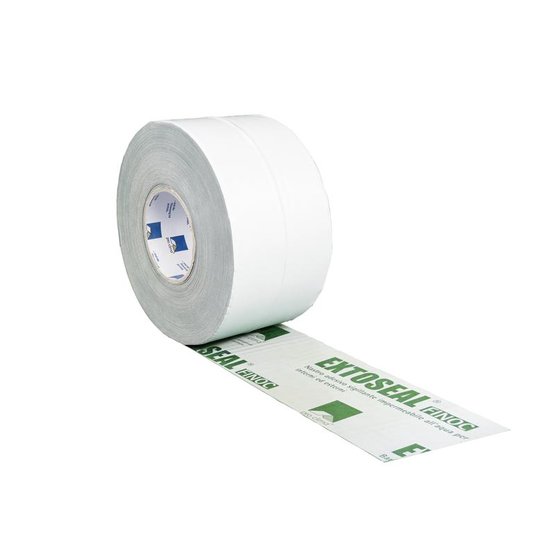
EXTOSEAL FINOC
Moisture-sealing adhesive tape, for interior and exterior use

Advantages
- Protects building structures against water ingress with its strong sealing effect
- Secure sealing: butyl rubber penetrates deep into the subsurface
- Easy to work with: very elastic – can adapt flexibly to subsurfaces and corners
- Subsequent work can be started quickly: adheres to stable mineral subsurfaces without primers
- Standards-compliant construction: for airtight sealing in accordance with DIN 4108-7, SIA 180 and RE 2020
- Excellent values in hazardous substance testing, has been tested according to the ISO 16000 evaluation scheme
Areas of application
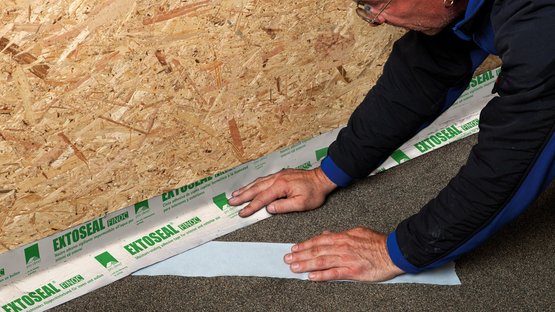
For creating seals underneath sills/sole plates/thresholds in timber structures, for sealing wood-based panels to smooth mineral surfaces, for taping sub-roof panels to one another (e.g. in roof valleys and transitions), and for sealing these to adjoining structural elements.
Splits on release film
| Tape width | Split (approx.) |
|---|---|
| 100 mm (4″) | 50 | 50 mm (2″ | 2″) |
| 150 mm (6″) | 75 | 75 mm (3″ | 3″) |
| 200 mm (8″) | 100 | 100 mm (4″ | 4″) |
| 300 mm (12″) | 150 | 150 mm (6″ | 6″) |
Installation instructions
Installation steps
General conditions
The adhesive bonds should not be subjected to tensile strain. Rub the tape firmly to secure the adhesive bond. Ensure there is sufficient back pressure.
Windproof, airtight or rainproof seals can only be achieved on vapour control membranes, roofing underlay membranes or facade membranes that have been installed without folds or creases. This product can only be worked with if daytime and nighttime temperatures are > 5 °C (41 °F).
If the initial bond is not satisfactory, a solvent (e.g. white spirits) may be applied to the grey butyl rubber side of the tape. The solvent increases the adhesiveness of the butyl rubber at low temperatures.
The tape is self-sealing under the effect of heat.
Substrate
Clean subsurfaces before applying. Fine dust and any loose fibres must be thoroughly removed by vacuuming. Adhesion to frozen surfaces is not possible. There must be no water-repellent substances (e.g. grease or silicone) on surfaces where adhesives are to be applied. Subsurfaces must be sufficiently dry and stable; if necessary, subsurfaces should be stabilised or renewed.
Permanent adhesion is achieved on all pro clima internal and external membranes, on other vapour control and airtight membranes (e.g. those made of PE, PA, PP and aluminium) and on other underlay and breather (WRB) membranes (e.g. those made of PP and PET). Adhesive bonds are possible with planed and painted wood, gypsum fibreboards, hard plastics and metal (e.g. pipes, windows etc.), hard wood-based panels (chipboard, OSB, plywood, MDF and wood-fibre underlay panels) and mineral subsurfaces such as concrete, unplastered masonry or plaster.
Pre-treatment with TESCON PRIMER is required in the case of adhesion to wood-fibre underlay panels or on smooth, mineral subsurfaces. No pre-treatment with primer is required on gypsum fibreboards if their surfaces have been cleaned and are dust-free. It may be necessary to apply a bead of adhesive sealant – e.g. ORCON F – underneath the tape to achieve reliable seals on rougher surfaces.
Particular care is necessary when working with older or multi-layer subsurfaces. It is your responsibility to check the suitability of the subsurface; adhesion tests may be necessary in certain cases. Pre-treatment of the subsurface with TESCON PRIMER will improve the adhesive bond.